

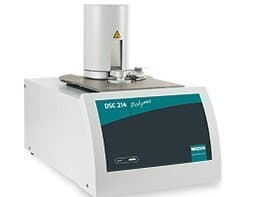
Máy đo nhiệt lượng quét vi sai DSC 214 Polyma NETZSCH
Differential Scanning Calorimetry (DSC) / Differential Thermal Analysis (DTA)
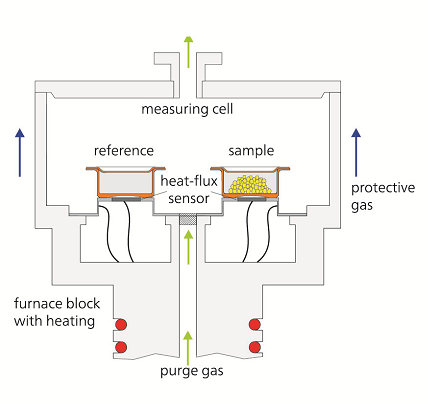
Thanks to its versatility and explanatory power, Differential Scanning Calorimetry (DSC) is the most-employed Thermal Analysis method. NETZSCH DSC instruments work according to the heat flow principle and are characterized by a three-dimensional symmetrical construction with homogeneous heating. Sensors with high calorimetric sensitivity, short time constants and a condensation-free sample chamber in the calorimeter cell guarantee high detection sensitivity and stable, reproducible baselines over the entire life cycle of a calorimeter: ideal qualifications for successful application in research and academia, materials development and quality control.
DSC 214 Polyma
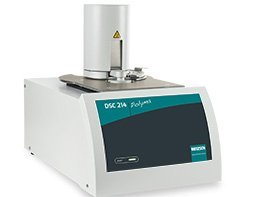
The System Solution for Efficient Characterization of Polymers
The New All-Inclusive Product Package for DSC Measurements
Easy-to-use, robust, precise, optimized for everyday use – these are the features of the innovative DSC 214 Polyma. The unique design of this instrument encompasses everything needed for successful DSC investigations – regardless of whether the user is a beginner or an experienced professional. Above all, it is the two new software developments that are setting new standards: AutoEvaluation and Identify. These have the potential to revolutionize DSC analysis.
- New all-inclusive 360° product package for the characterization of polymers
- Easier sample preparation than ever before
- Automated measurement and evaluation
The First Classic Heat-Flux DSC for Fast Cooling
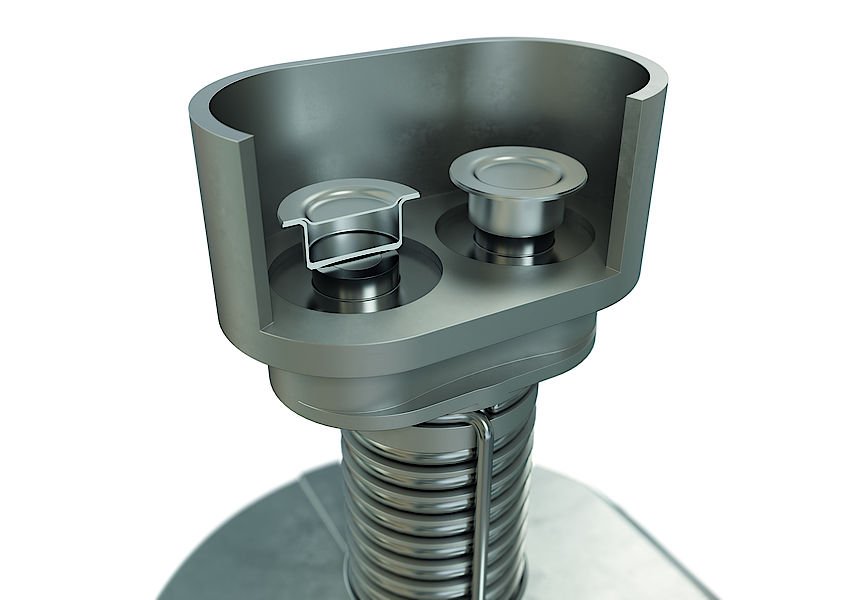
Integrated in the DSC 214 Polyma is an oval furnace with a very low thermal mass (Arena® furnace), which allows for heating and cooling rates of up to 500 K/min – values previously unachievable with heat-flux DSCs. Temperature profiles can now be realized which are far closer to real processing conditions.
Groundbreaking Sensor Technology
The novel, patent-pending Corona® sensor is comprised of a core of nickel chromium and an outer ring of constantan. Both materials are diffusion-welded. This generates a defined, ring-shaped zone where the temperature under the crucible is recorded, resulting in a significantly higher reproducibility – especially in combination with the Concavus® crucibles.

By combining a very low thermal mass furnace (Arena®) with a robust, sensitive sensor (Corona®) and optimized crucibles (Concavus®), the DSC 214 Polyma achieves impressive performance data.
Along with fast heating and cooling rates – which also allow for isothermal crystallization experiments – this is expressed particularly by the Indium Response Ratio, which is the achievable height-to-width-ratio of the melting peak of indium.
A high value for the Indium Response Ratio describes a peak that is not only tall (high sensitivity), but also narrow. This allows for the detection of weak effects and, at the same time, for the reliable separation of peaks occurring in close succession.
The DSC 214 Polyma features a high Indium Response Ratio of over 100 mW/K – a value which is not only far greater than average, but actually one of the highest ever published for a DSC instrument.
Cần thêm thông tin hoặc tư vấn kỹ thuật?
Nếu Quý khách cần thêm thông tin chi tiết về sản phẩm, thông số kỹ thuật, ứng dụng thực tế hoặc yêu cầu mẫu thử, đội ngũ của chúng tôi luôn sẵn sàng hỗ trợ.
📞 Điện thoại: (024) 6687 2330
📧 Email: sale@pemax-mte.com
Hoặc gửi yêu cầu qua biểu mẫu liên hệ hoặc trao đổi trực tiếp qua hộp chat ở góc phải màn hình.